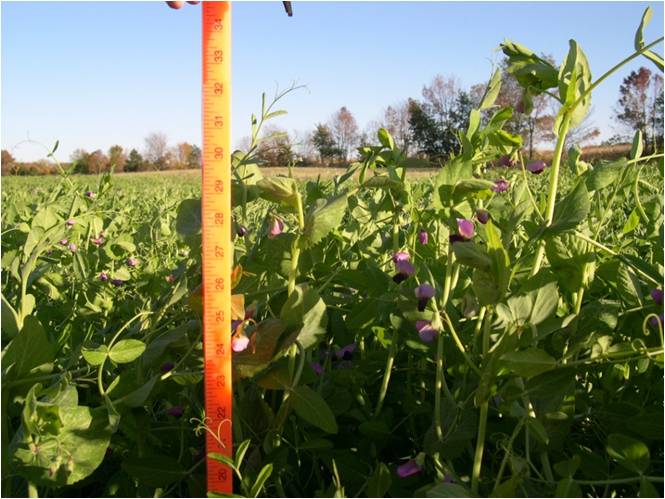
Austrian Winter Peas are a good cover crop for producing nitrogen. These peas have better cold tolerance than Canadian Field Peas yet still grow well when planted after wheat or other summer annuals. It’s preferred to plant them in August after the hottest days are normally past. Below I list the advantages and disadvantages of Austrian Winter Peas.

Advantages
- Produces 60-120#/acre N
- Generally Winterkills
- Easy to kill with herbicides
- Mixes very well with Oilseed Radish
- Relatively inexpensive to use as a cover crop
Disadvantages
- Best to be planted 1/2″ or so
- Aerial application provides challenges for stand establishment- but has worked!
- Generally Winterkills
- Needs 5-6 weeks growth for best results
- Only one grazing/harvest can be expected
Dave
What is your experience with A. Winter peas, will be of value as a cover crop if flown into soybeans at leaf drop in Lucas Cty Ohio area? Will they get that 5 to 6 weeks of growth as mentioned above. The same question with crimsom clover.
Flo, Flying peas into standing crops is pretty risky. I have seen it work pretty well…but only into good moisture (and it stayed pretty moist). Peas work much better incorporated to a depth of 1 to 1 1/2″ deep. On the other hand Crimson Clover works very well flown into soybeans or corn at the right maturity stage. The nice thing about Crimson Clover is that it most likely will live through the winter and produce more nitrogen in the spring as well. The peas might do that but crimson clover will be more winterhardy most years.
my question is if i wanted to raise peas to combine for my own seed use how would i go about it. what time of year for seeding, are they hard to harvest. i live in east central missouri. thanks
Hi Marty, I will have to admit that I do not know the answer to your question. Peas are generally raised in our northern tier states and in Canada. maybe some of our other readers will know the answer to raising peas in your region. Sorry I could not be more helpful. Dave
HI me again I feed my goats and horse a mix of baled winter pea barley and oats.They way they ate it you would have thought they died and went to heaven.but this year my little pasture is useless and I am going to have to feed store bought even more than normal but if by some miracle I could plant something like this,maybe I still have time.I live in ne texas most of my soil is clay .have any advice.
Jacquie, You are right, animals love to eat the mix that you had! The good news is that all of those are also great for building soil. I believe it is too late to plant peas at this late date if you want to graze them For soil building it might still work, but not for harvesting of grazing…they would be too small.
I’ve planted Austrian Winter Pea in the Fall in SE Oklahoma and they were growing to 7 feet in May/June.
Dave,
Can I plant a winter pea and oat mix in July (after wheat is harvested) and get a forage harvest that same fall assuming proper weather provided? If so, on 45 lbs/a, how much yield can I assume either dry or wet hay? Does it ferment well?
Thanks
Steve
Steve, That is a good question and the answer is …maybe. If we have a cool and moist summer than probably “yes”. If there is a hot dry summer than probably not so good on yield. The later is July you plant the better as most areas generally get more August rains. I’d probably wait until August to plant if you can as you will get cooler temps and a better chance for moisture (most years),
I am seeking a cover crop for the sole purpose of building the soil over the winter. I would till it into the ground for spring planting of my garden. Comments or suggestions would be appreciated.
Will, Many different cover crops could be used for what your goals are. I would suggest a legume (peas or crimson clover) + a grass (Oats or Rye) will work well together and help build your soil! Good luck! Dave
Hi Dave,
I have a CRP field in Huron County Ohio that I will moldboard plow on October 1. I will drill it with cover crop within a week or 2 after that, depending on weather. I definitely plan to plant cereal rye to hold the soil. Additionally, since it is going to corn in the spring of 2014, I am hoping to add a legume to fix some nitrogen “for free”. I’m willing to drill it twice to get this benefit. Do you think that Austrian winter peas is a good candidate or am I too late? We’re in zone 5a with an earliest frost date of 9/20 – I expect a “hard” frost in late October/early-November. I also have the possibility to run something through the small seed box when I’m drilling rye – maybe hairy vetch is an option? Or, do I give up on nitrogen altogether? What do you recommend? Thanks! Eric J.
PS: I’m planning to broadcast cereal rye on the entire farm this fall after corn/bean harvest. I’ll incorporate it with a vertical tillage tool, eliminating that tillage pass from next spring’s planned fieldwork. Wish me luck! -EJ
Eric,
I know of a gent in Ashland County Ohio that plants Austrian Winter Peas after harvesting his soybeans and he has had success each year of getting the peas up 4-6″ in the fall then they have over wintered! In the spring the peas get up to around 10-12″ then the farmer kills them off (Tills them in?) and he enjoys all of the benefits of what peas bring to his fields. Rye is a “no-brainer”…peas have greater risk but they may be worth a try! Please keep me up to date on what you do! Oh, be sure to inoculate the peas. Dave
hello, just thought i’d comment on all this fascinating work all you farmers in the states are doing with cover crops, no-till e.t.c. I was completely landless up until two years ago but now have a small plot roughly 50′ by 15′ for veg n’ what not..i’m basically a frustrated farmer but i do have my feet in the soil at last and can’t get enough of this soil health ‘revolution’. It really is awesome.. i decided to ‘no-till’ one year ago, had tried green manuring years ago but have really taken a quantum leap in my level of enthusiasm and ‘knowledge’ since discovering what you guys are upto across the pond..Just wanted to say thanks really to all you farmers for doing what your doing and sharing all this amazing knowledge..i’m just itching to get my covers in next year..cheers!
Thanks James! Best of success over there!
I was thinking of using the A Winter Pea for needed N. I live in S.C., very hot, so 1) when would be the best time to plant 2) can this be done year-after-year? Thanks in advance.
Paul,
Planting winter peas in late August through mid-late September in your region. You can plant them annually. Be sure to inoculate the peas each year you plant them. They do like cooler temperatures!
Dave,
I’m interested in planting some cover crops for this winter. I know it’s a little late already, so can you recommend some that may still work for east-central Texas? It’s quite hot and humid here so I think I met still have time to get a decent cover. I’m thinking of winter wheat and a legume such as Austrian winter peas or clover. Any suggestions would be greatly appreciated. Thank you.
Joe,
Peas and Winter Barley or Rye or Wheat would be very good. Also, Annual Ryegrass and Crimson Clover would be a great too!
When
is the latest you can plant Australian peas
Stacy, It depends on where you live. I’d say a good rule of thumb is plant the peas 5-6 weeks before a killing freeze. The longer they grow the greater the benefit. Best of success!
When will Austrian Winter peas start to bloom in N. TEXAS? (DFW area)
If grown with ryegrass and cut before peas bloom, for baleage, will peas have regrowth?
I am not sure when Peas will bloom in North Texas. Sorry…Usually peas do not regrow well after they have harvested. The regrowth would typically be very limited if any.